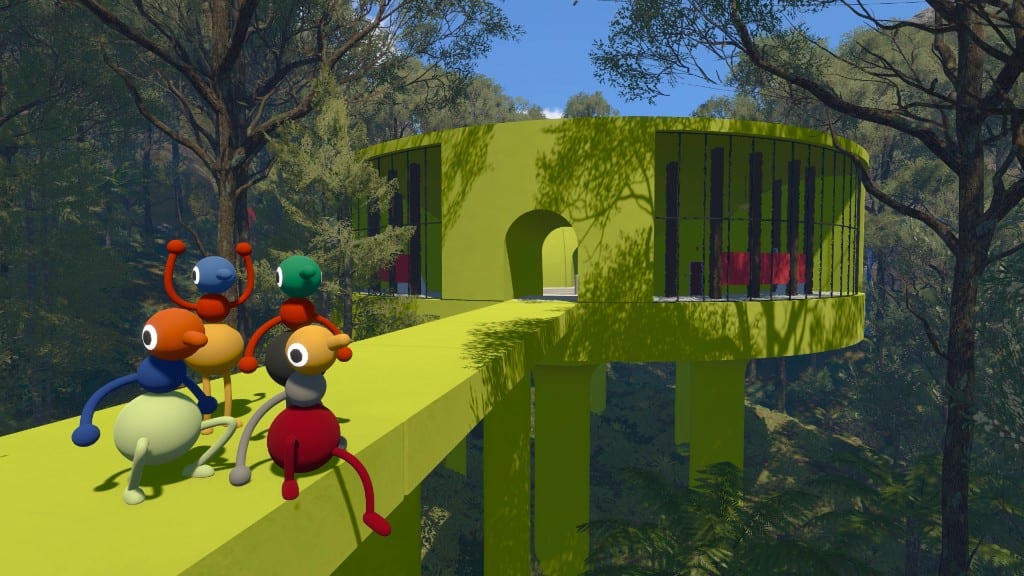
Whether it’s chemistry or spiritual voodoo, nothing will ever beat the energy exchange between two people who meet face to face. But The Big Walk comes really damn close.
Nick and I
The Big Walk is a (big) walking simulator with puzzles and a minimal narrative peppered in. You are thrown into a room that explains everything you can do (unlike life) and when you are ready, thrown into the decent-sized open-world to go explore (just like life).
While you can roam around by yourself, you’ll quickly need a helping hand to progress. At least one, a couple if you can. I played it with my friend Nick, who I met just a couple of months ago in Kyoto, and we hung out every day of the Indie Game Conference BitSummit. Nick then went back to Chicago while I stayed in Asia. That’s fifteen hours of time difference. He’s sorting his life out, I’m heads-down building things by myself. There isn’t a lot of opportunity to meet up.
But present us with a videogame world to explore and an opportunity is suddenly created.
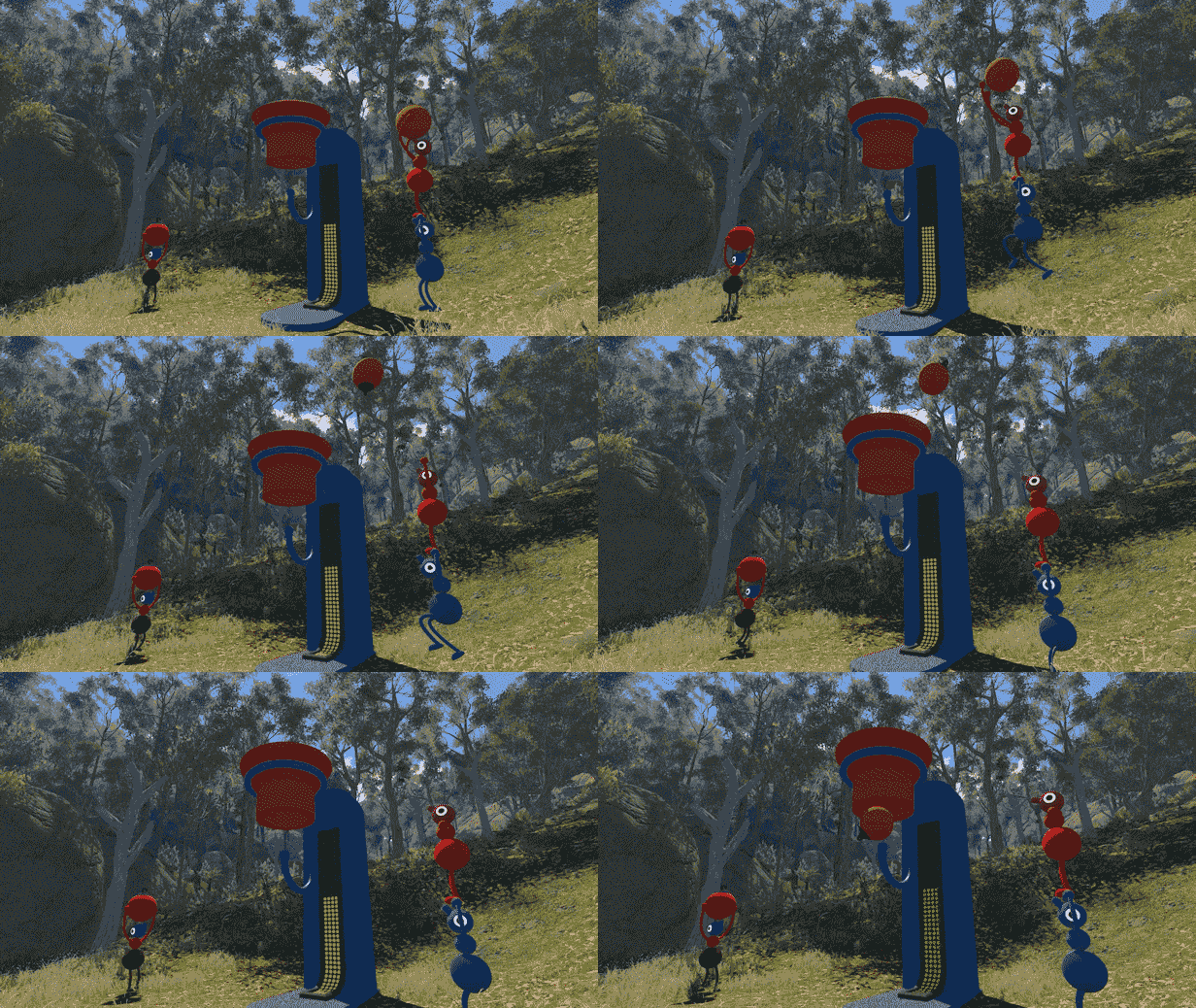
Nick’s more of a Hades / Monster Hunter gamer and The Big Walk isn’t something he’d normally pick up. I expected an hour, maybe two, before he called it quits. Yet by the time we were finished, ten hours later, he had gone through the same transformation people go through when they’ve scaled a small mountain. He needed a good one on one social time, a good hang. Something that used to be more available offline.
Videogames are a perfect third space
“Third spaces” are where people socialize, think cafés, bars, restaurants, parks, gyms and so on. While these are still around, the culture of many third spaces has been “optimized” by big data thinking, leaving dehumanized self-service kiosks, robot baristas, and the doom itself, eyes boring into the smartphone.
Videogames had their own third spaces in MMOs like Runescape, Guild Wars or WoW. Similar to The Big Walk, you could wander around by yourself, but really the genre shined when you befriended other people. The sociable fantasy city trade squares filled with people “/y WTS POTIONS” were replaced with monetized Roblox slot machines and italo-slop brain dumb scooby-doob-doob (don’t ask me I don’t know either).
Earlier this year I conceptualized a game/app ONMTN, which grew out of an idea about sharing audio messages to maintain long-distance close relationships. That idea evolved into a digital hiking game where you walk, talk, and leave messages along the way. The Big Walk does extremely well in validating my thoughts. Thanks for that.
Another genre The Big Walk could be incorrectly likened to is friendslop, due to the game’s simplistic presentation and focus on friend-play. Friend-play. Where friendslop games put simple but deep game mechanics into repeatable environments for players to keep coming back, The Big Walk is one singular thing. A Big Hike you go through once, and you remember it for the moments along the way. It still invites streamer-friendly moments for their wholesomeness rather than absurdity, annoyance and rage. There’s no rage in the land of the bright blue, yellow and green.
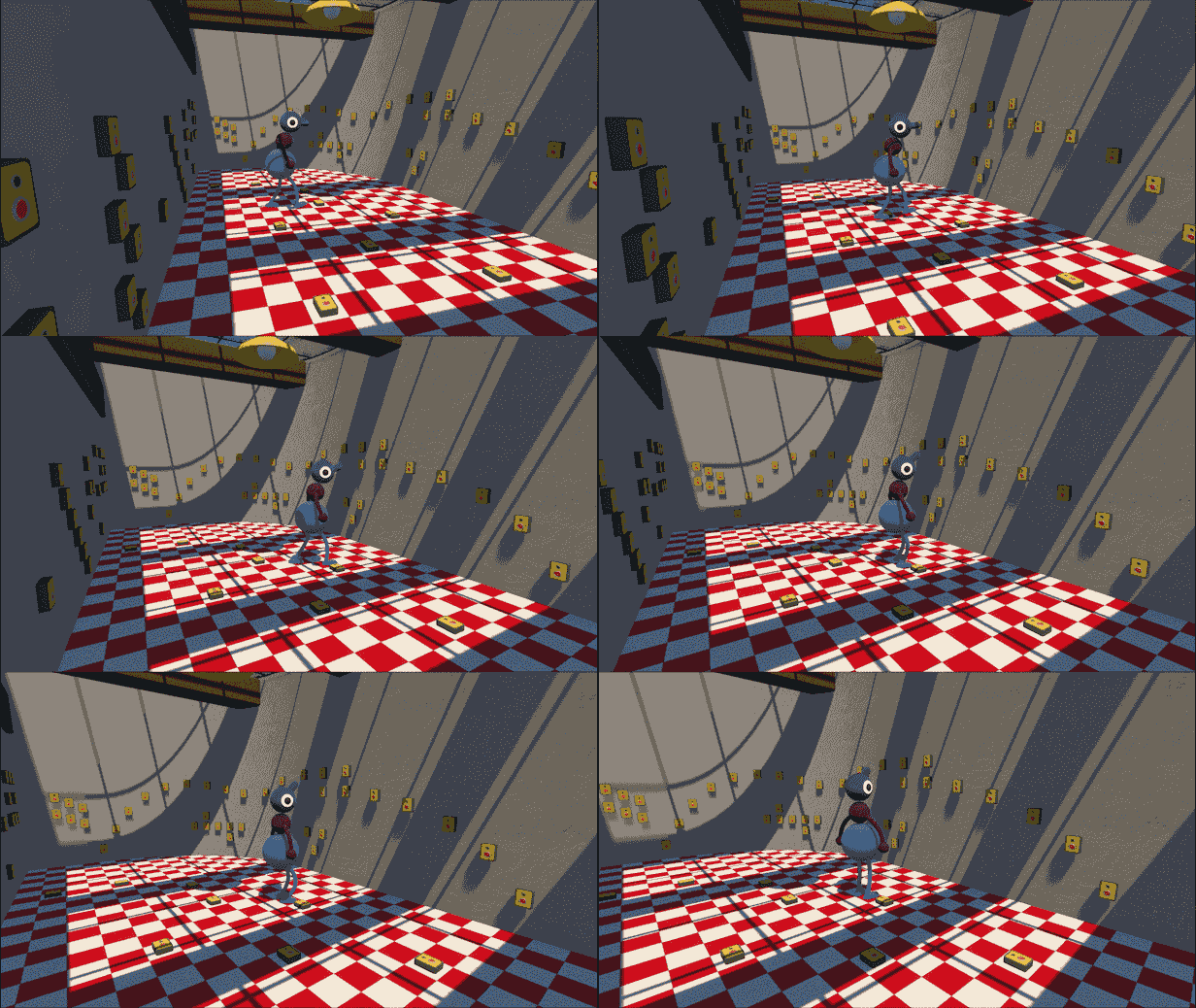
The colorful geometric shape-filled puzzle island offers situations and tools to ease the journey’s troubles. From making it easier to talk and find friends across distances, carrying more than one thing, or finding each other in the pitch dark, the player is never penalized for just having a good time walking around.
The charming neighbour
Now the game at its release is beloved by critics, and I can understand why. It has that nature hike effect, combined with the case of the European girl/boy next door charm. Looks distinctive, sounds unique, but then you see the cracks past the platonic interest: unrewarding dead ends to exploration, one-dimensional transportation unlocks, a narrative sewn in last minute.
The Big Walk is an adventure you do together as a group. Somehow it is both easy and difficult to find people to go through the whole island. As your group shifts, yet the puzzles remain the same, you don’t want to bring in any more people.
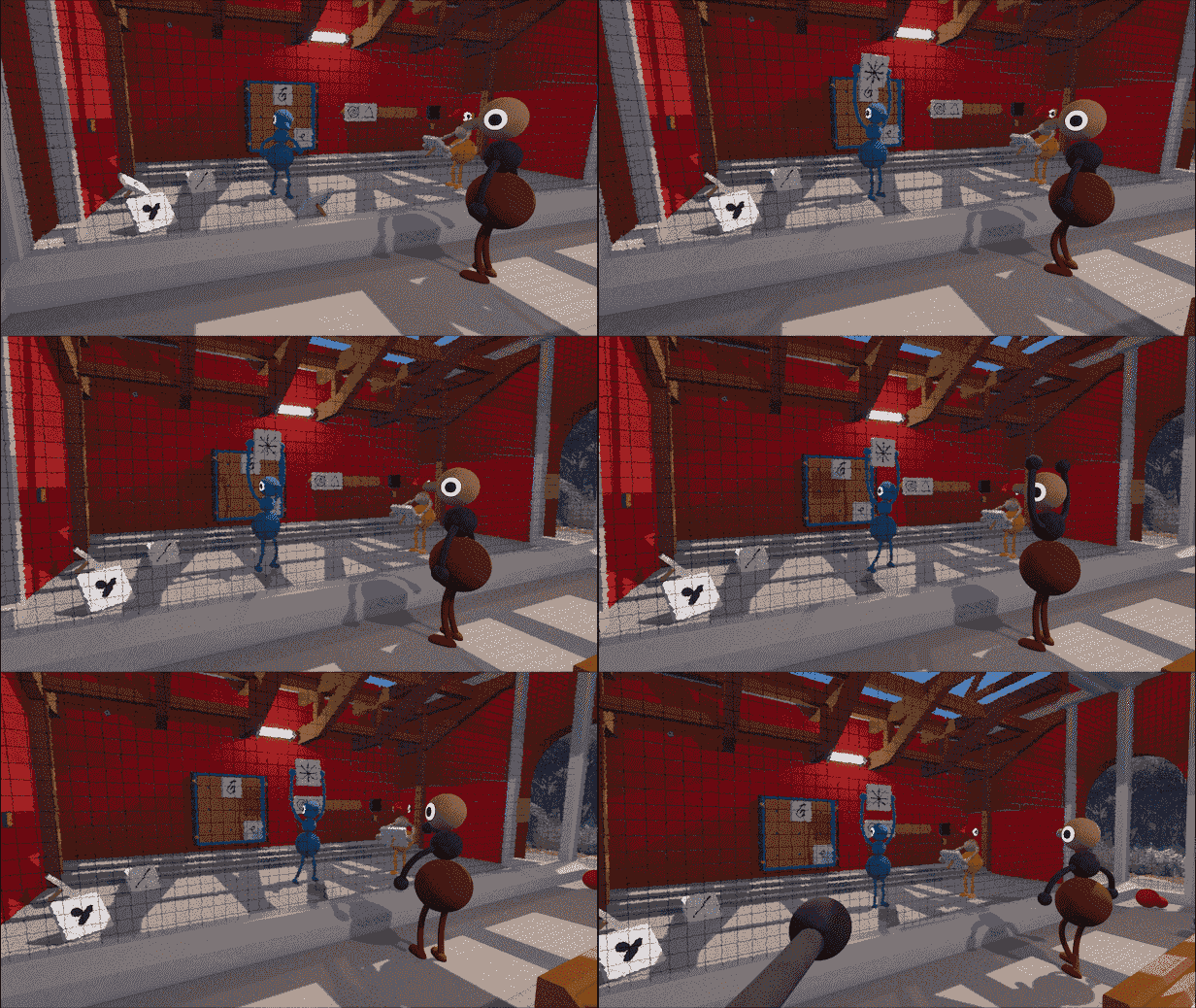
Case in point was a random person who joined about two hours into our game. I’d left the game open for others to find us, but as we progressed further into the island, Nick and I didn’t want to have puzzles spoiled by random people jumping in. We ventured together but found it less enjoyable because it felt rushed. When Mr. Rando disconnected, we were happier for it.
Smile like an idiot
The Big Walk feels like a genuine work between friends who enjoy playing together. Nothing in the game feels forced, maybe misplaced or unintentional, but never aggressively produced to force my attention for a little bit longer. I’m just a big-eyed stick-sphere dude carrying my gourds, in a playful kindergarten-colored environment, enjoying the nature. My motor skills involve bobbing knees, hand gestures and sitting down to watch the beautiful rose-colored sunsets.
The final stretch of the game has cast the widest smile on my face in a while. After the full-day session, Nick and I had acquired an absolute synergy. I didn’t need to talk, he didn’t need to talk. We gestured with hands, but understood each other perfectly even without it. One by one, each puzzle of the game fell quicker to our bro-bond. Can you imagine that perfectly choreographed fight scene in any Marvel movie? That was us. Right up to the very last goodbye wave to Nick, I was the sticky-sphery doo-doo dude until I too passed through the white light beyond The Big Wall. That’s all it takes for people to meet and connect across vast distances.